Savoy Humidor Review
About six months back, I found myself staring at a blank screen, trying to figure out which humidor to snag for my next review project—this Savoy Humidor Review included. I have a bit of an obsessive streak, so instead of just picking one, I went completely overboard and ended up buying seven of them.
The thing about shopping for humidors online is that it’s a minefield; I went down a rabbit hole and quickly realized it was going to be a disaster. Every product page has some version of the same promise—Savoy Humidors provide an optimal environment for storing and aging your cigars. You stare at these glossy photos, but they don’t tell you the whole story, and frankly, they didn’t inspire much confidence. So, I set some ground rules for myself: the box needed that classic, traditional humidor aesthetic, it had to hold around 75 cigars, and the price tag had to stay under $175 before taxes and shipping.
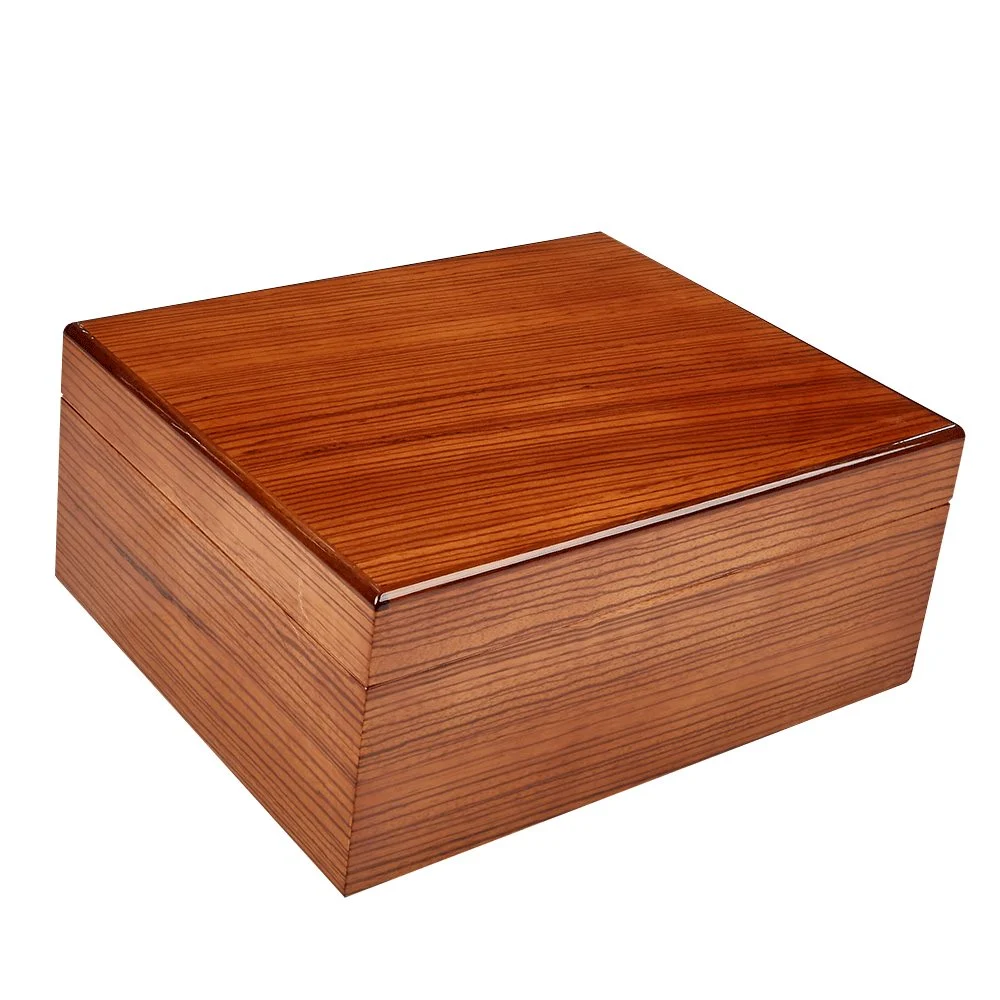
This article marks the kickoff of this series, and if I can keep my schedule straight, you’ll see a new review dropping every other week or so for the next four months. When the mountain of boxes arrived at the office, I didn’t play favorites; I just randomly picked one to start with—and for this Savoy Humidor Review, fate handed me the Savoy Marquis.
Savoy Humidor Review (Quick Verdict): The Savoy Marquis absolutely nails the classic desk-humidor look, and the included hardware feels more premium than most boxes in this price range. But the seal is the make-or-break issue here—there’s a visible gap that leaks air, which makes stable humidity harder than it should be. If you want a traditional box for the vibe, it’s tempting; if you want reliability with minimal babysitting, keep reading.
What is the Savoy Marquis?
If you’ve browsed the shelves of any decent cigar shop in the U.S., you’ve likely seen this brand. Ashton basically splits their humidor lineup into two distinct tiers. You’ve got your standard Savoy line, which is what we’re looking at today, and then there’s the upgraded Savoy Executive series—a line I’ve loved for a long time because they are genuinely solid boxes.
As is typical with Ashton’s offerings, the Savoy humidor comes in a few standard sizes, and here is how they break down the specs: Each model is crafted from fragrant Spanish cedar materials.
- Small: (10 1/4 inches x 8 3/4 x 4 1/2) – Rated for 25 Cigars
- Medium: (11 3/4 x 9 1/2 x 5) – Rated for 50 Cigars
- Large: (13 1/2 x 9 3/8 x 6 1/4) – Rated for 100 Cigars
It’s worth noting that the Large model isn’t just bigger; it’s actually built differently, featuring a removable tray and an external lock and key set. Those are two bells and whistles you just don’t get on the smaller siblings.
When it comes to looks, you are spoiled for choice. The Marquis is just one flavor, but the line includes African Teak, Ash Burl, Beetlewood, Black Calabash, Bubinga, Ironwood Marquetry, Macassar, Mahogany, Mahogany Glass-Top, Mesquite, Pearwood, Rosewood, Walnut, and Zebrawood. I’ve also seen the Bubinga version in person, and The Savoy Bubinga Humidor is a robust humidor with a unique wood finish. On my unit, the colour is a chocolate brown, and it absolutely scratches that “classic desk humidor” itch. Aside from the Glass-Top version, I’m willing to bet my lunch money that the guts of these boxes are identical, regardless of the fancy veneer on the outside.
How Much Does the Savoy Marquis Cost?
For this specific unit, we shelled out $111.95, and that was before tacking on tax and shipping. For the looks alone, that price feels like a Great find—at least until you start caring about seals and stability.
What’s Included?
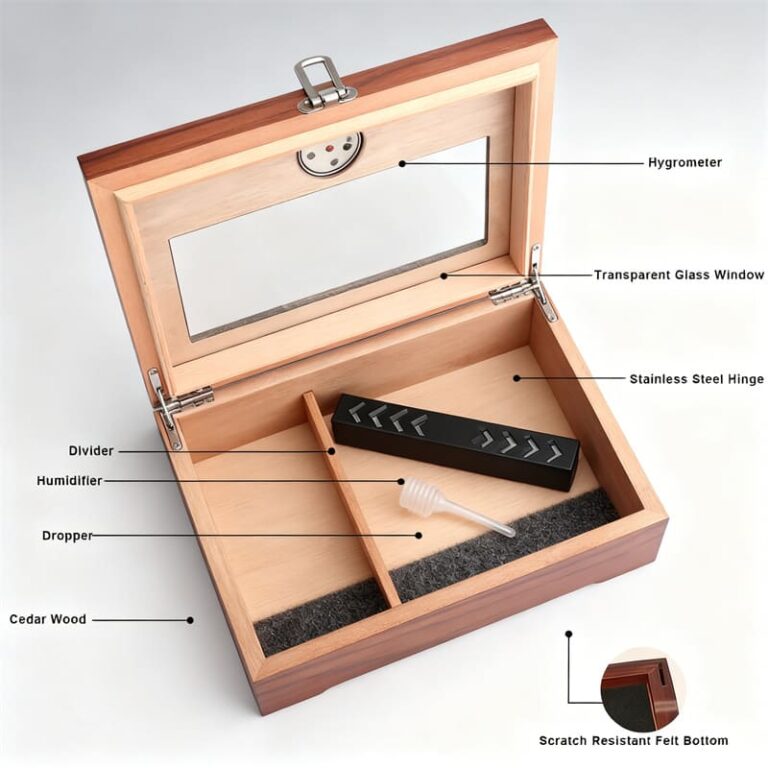
Open the box, and you get the humidor itself, a divider strip, an analog hygrometer, and the Savoy Humidification Device, which is essentially a casing for florists’ foam. And I’ll give them this: The Humidifier Seems Better Built Than Most. The guts are still foam, but the plastic housing itself feels way more solid than the flimsy stuff you usually see bundled in at this price.
Let me give you my two cents on florists’ foam, and this isn’t just a knock on Savoy, but the material in general. It’s that old-school green foam brick that your aunt uses to keep her flower arrangements from dying—that’s literally why it exists.
The theory is that when you soak it with distilled water, it helps reduce mold risk and absorbs excess humidity if things get too swampy—specifically over 70 percent relative humidity.
In practice? I’ve never found it to work that well. There’s actually evidence suggesting you need a lot more propylene glycol to actually hold a steady 70 percent RH at room temperature. For the sake of this review, I stuck to the industry-standard 50/50 solution method.
One nice touch I noticed immediately is the lid; there are three magnets pre-installed. One holds the hygrometer, and the other two anchor the humidification device. The hygrometer is old-school and simple—It does not connect via wi-fi, but it does work, very well for a quick at-a-glance read, as long as you don’t treat it like lab equipment.
Savoy Humidor Capacity: How Large Is It Inside?
Breaking out the tape measure, the bottom interior section comes in at roughly 10.75 inches wide, 8.45 inches deep, and 3.67 inches tall.
If you plug those numbers into Humidor Discount’s calculator, technically, you could jam 63 robustos in there, though that’s more of a volume rating than a practical guide. You might be able to squeeze in a few more since there is a little headspace in the lid, but don’t count on fitting a whole lot more.
The Testing Process
Since I had seven of these competitors sitting in my office, I needed a standardized gauntlet to run them all through.
My goal was to see how they performed right out of the box with the included junk, and then see if they improved when I switched to a reliable Boveda setup.
To track the data, I used a SensorPush. It’s a slick little digital sensor that tracks temperature and relative humidity minute-by-minute and shoots the data right to my phone.
Here is the four-step torture test:
Seasoning: I spent two weeks seasoning it using a new sponge soaked in distilled water resting on a plate inside. I re-soaked the sponge after week one and yanked it out after two weeks. This is crucial to inject moisture into the wood. If you skip this, the dry wood will just suck the life out of your cigars. That leads to headaches and, frankly, ruined smokes.
Included Humidifier: For the next four weeks, I ran the box with the factory humidifier, no cigars, lid closed tight. I wanted to see how the manufacturer intends for it to work. After that month, I tossed their humidifier.
Boveda: Next up, six weeks with three 60-gram Boveda packs (69 percent), no cigars, lid closed. This isolates the box’s seal quality from the variable of the included humidifier.
Dry Cabinet: Finally, two weeks in an electronic dry cabinet set to a parched 36 percent RH, with just the SensorPush inside. This lets me control the outside environment perfectly to see how fast moisture bleeds out. It’s the ultimate seal test. I did this with no humidification device inside to see pure moisture loss.
Savoy Humidor Review Test #1: Included Humidifier Performance
It wasn’t exactly a shocker, but that florists’ foam humidifier just kept pumping out moisture way past the seasoning phase. Ashton suggests refilling this thing every two weeks, which honestly feels like way too much maintenance for my taste. Also, for the record, the device started growing mold, which makes sense since it spent two weeks sitting in 80+ percent humidity.
Savoy Humidor Review Test #2: With the Bovedas
When I switched to the Bovedas, you could see the struggle. That orange line on the chart stayed high for the first 48 hours because the packs were fighting to absorb the swampy mess left by the foam humidifier. It took a full two days just to get under 75 percent RH.
It took another week before it finally settled down below 70 percent and hit the 69 percent target. Considering how waterlogged the Savoy was, none of this surprised me. I kicked myself for not weighing the Boveda packs afterward, but I guarantee they came out heavier than they went in, acting more like dehumidifiers than humidifiers.
Savoy Humidor Review Seal Test: In the Dry Cabinet
Here is where things got ugly. The Savoy bled out nearly 16 percent relative humidity during its two-week stint in the dry cabinet.
It’s a little tricky to compare this directly to the others because this Savoy humidor was the only one that entered the dry box soaking wet—starting well above 60 percent, almost near 70. Basically, it had a lot more moisture to lose than the competition. But the takeaway is undeniable: this Savoy humidor does not seal well.
The Good
I gotta be real, this looks like a proper humidor. When my buddy Desmond asks me how to store his sticks, I usually tell him to grab a plastic bin and throw in a Boveda. There was a time when Spanish cedar was the peak of tech, but that’s over. If you want airtight, buy plastic and skip the seasoning headache.
But let’s be honest, most people want that vibe—the form is as important as the function. A plastic tub doesn’t look cool on a desk. This box satisfies that aesthetic need perfectly, and Its refined design makes it a great addition to a home office or study.
I also really dug the magnets on the lid. Even though the lid itself isn’t magnetic, having those pre-installed mounting points for the hygrometer and humidifier is a step in the right direction.
And credit where it’s due, the included humidifier unit feels premium. Compared to the other seven I tested, this one felt the most solid and well-built. I mean, the insides are still trash and I wouldn’t use it , but kudos to Ashton for not cheaping out on the plastic casing like some other brands do.
I also skimmed customer reviews for Savoy Cigar Humidor Humidifier just to see if my experience lined up with what other people say. Some of the praise is… enthusiastic. You’ll see lines like “Beautiful! The humidor is beautiful.” and “Fantastic Humidor! This humidor is INCREDIBLE”—and honestly, on looks alone, I get why people talk like that. You’ll even catch a few saying it “performed excellently for me” and “The quality is unbeatable.”
The Bad
Here is the deal-breaker. In this Savoy Humidor Review, the reason I can’t recommend the Savoy Marquis boils down to one word: Gap. I know some folks will swear “The quality is unbeatable,” but a visible air leak is the kind of flaw that bulldozes right through everything else.
On both sides of this box, there is a visible fissure that starts small and widens as you go toward the back. The front sits flush, sure, but by the time you look at the rear, the gap is wide enough that I could literally see the gold hinge mechanism glinting inside. That gap means it doesn’t matter how good your humidifier is; this Savoy humidor is perpetually leaking air.
It also feels weirdly light. Empty, it tips the scales at around 4.4 lbs, which is noticeably lighter than the other units in this test group. It just lacks that substantial feeling. I usually say the same thing about the Savoy Executive line, but that one is actually one of my favorites despite the weight.
The Competition
As I mentioned, I went on a shopping spree and bought seven distinct humidors that I felt represented this market segment. I’ll be updating this list as I finish those reviews. Keep in mind, these prices are what I paid before shipping and taxes.
- Craftman’s Bench Havana 90-Cigar ($79.95)
- Yannabis Cigar Humidor ($159.99)
- Quality Importers Old World ($94.99)
- The Deauville Tobacco Leaf ($99.99)
Colibri Heritage Humidor ($495) – If you insist on wood and want quality that lasts, you need to spend closer to $400. The Heritage is often found at that price, and it smokes this competition. And yeah, I can already hear someone saying, “It is more then 3x more money than the ones I have”—fair point. But at that tier, you’re paying to avoid exactly the kind of manufacturing defect that ruins the Savoy experience. It’s solid, avoids these manufacturing defects, and looks modern—though the style isn’t for everyone.
Savoy Humidor Review (Final Take): The Savoy Marquis looks the part and the included components feel nicer than expected, but the seal gap is too big of a flaw to ignore if you care about stable RH. I’ll keep updating the competition list as the rest of the reviews publish—if you want a box that behaves without constant tweaking, start with the better seal performers first.